So yesterday I launched davidmasonhawes.com – my new website and home for my regular ramblings on a broad range of subjects… but mostly I’ll be here talking about how my work in the world of digital is (I hope) making a positive difference in the world.
This is my first update since the turn of the year – all my other posts went straight into my LinkedIn profile, should you be interested. So a belated ‘happy new year’ (it very much feels too late to be saying this, no!?).
This time last year
I want to start with a bit of personal reflection. This time last year I had just returned to work after 6 weeks off, having been diagnosed with burnout by my GP. I’d had a fairly torrid time of it for 3 or 4 months prior in the lead up to Christmas 2024, suffering some very real physical symptoms (chest infections were my achilles heal) alongside what on reflection were probably some mildly depressive-like episodes.
It was during that period that I applied for the role I am now in at the WJEC, having come to the conclusion that I needed a change for my own personal wellbeing and to get a better work/life balance with my family. My wife and I have reflected since that I’m not sure I would have coped with the stresses and challenges of adoption had I not made the change. I’ll talk more about our adoption experience another time.
So what’s changed? Well – with the NHS under such huge pressure, I felt that personally. It’s not like there isn’t pressure in my new role… but I do feel that I’m now in a role where I can better manage the demands placed on me personally. I think I’d almost become institutionalised to working regular 9/10hour days, every day – lots of out of hours work – which was slowly wearing me down. I’m now much more disciplined about how I manage my own time, both in work and out. Sometimes it needs a change of scenery to make you realise that you can’t keep running full tilt.
I read A LOT whilst I was off… but one piece of reading in particular resonated strongly with me whilst I was off and I would thoroughly recommend the writings of Dr Clare Ashley for anyone struggling with burnout themselves, particulary so if you work in the NHS. Her book – The Burnout Doctor – is a really great read and I saw so much of myself in it. It gave me some practical pointers and tools, to better manage my own time and I still apply many of the practices she promotes in her book, to keep me in check now I’m in my new role. Go take a look!
Back to work
I returned to work at the start of January following the best part of two weeks off. The WJEC closes its doors fully for the Christmas period (we also have a slightly longer ‘enforced’ A/L period at Easter) – something I’ve not experienced before and something which I already see as a real privilege. To know that you can take that time off and won’t come back to a truck-full of emails on your return is really quite something and is one example (amongst many) that reflects the culture and values of the organisation and how it treats its staff. Having not had any time off since late-July due to my adoption commitments, the break was very much needed.
The start of 2026 kicked off at a rapid pace for me – maybe an unintended consequence of the whole organisation being off over Christmas and New Year is that everyone returns with real gusto in January! The first two weeks back in work were super busy… but manageable. Things are settling down back into a good rhythm, but I thought i’d highlight some key achievements and learning from the last few weeks.
Formal launch of our new change management approach
In my previous blogs I’ve spoken a lot about the introduction of a new IT change management approach at the WJEC, a piece of work that I have designed and led. Well I’m really pleased to say that this has now been formally launched and went live to the whole organisation in early January. Still relatively early days but feedback so far is that staff really welcome the transparency of the new process and that it is doing what it intended – i.e. to deliver and open approach to how we review and select what change activity to take forward. A real living and breathing example of ‘working in the open’.
The approach we’ve implemented is very similar to something that I – along with a few colleagues – tried to implement in a previous organisation. That attempt didn’t really land and I took a lot of learning from that, which I think/hope stands the process implemented into the WJEC in good stead.
Some personal reflections…
- Make time for discovery – I spent a good couple of months understanding what was currently in place (or not) and how it was working, linking in with a small circle of learned colleagues (thanks in particular to John McGrath & Jon Hayward) before making a first pass at a new process. This time was crucial in making sure any new approach sat well within the current order of things at the WJEC.
- Embrace the pilot phase – once we had an initial outline of an approach, I spent a few months road-testing it with a slightly wider group of staff, using them (in a nice way) to validate and feedback on the process, tools and definitions that we use to drive requests through the process. This was time really well spent, as some issues were identified and we made material changes and improvements based on the feedback. The fact that issues emerged in a controlled way, rather than after a full launch helped make sure that by the time we did finally release it, we’d ironed out those niggles and folks were more receptive to it.
- Accept it won’t be right first time – in my previous role I was quite fixated on how the process should work and wasn’t particularly flexible or receptive to change. I wasn’t helped by being overwhelmed with work, which made it challenging to do effective discovery and piloting… but on reflection I should have taken a different path. I’ve taken a much more open approach this time around, inviting feedback and being transparent about what we’ve changed during the design process and why. I think / hope this has helped me to build trust in the process, but also seems to have helped me settle into the organisation and for folks to get to know me and how I like to work.
- Be disciplined – the process is governed by a monthly change board, where we review new requests and discuss their scheduling. I’ve already received requests to expedite certain changes, which I’ve pushed back on. I’ve reflected on previous blogs that we’ve been dealing with a situation where we’ve simply had too much work on the wheel – having a firm commitment in terms of the ‘control gate’ used to manage that new demand forces people to plan better and raise requests earlier… making it easier for everyone to have early sight of potential new work. It also means I can be clear in managing expectations. So far this appears to be landing well.
- Tool up – to support the process we use a published SharePoint List to log and track all new requests. This is available to whole organisation, with various views to show progress, what’s in development and what’s on the backlog. Really simple to set up and really easy to manage… but by publishing on our staff intranet, once again it pushes the principle of working in the open. It’s clear for all to see where various requests are in the wider process and what’s on the backlog and likely to be next. We use a simple MS Form (connected to the SharePoint List) to capture new service requests – this form doesn’t ask folks “what do they want” (though some do still solutionise a little); rather, it asks them a series of questions of what is the business problem they wish to solve. We also ask them to clear lay out the benefits to the organisation should their request be fulfilled, using criteria aligned to the WJEC strategy. This all helps with the review and prioritisation process.
- Automate – I’ve used Power Automate and other features of 365 to reduce the admin burden for the process. I didn’t take this far enough in my former role, so it became cumbersome for all involved. I knew I needed to address this in order to land it at the WJEC. Automated emails are set up, to notify the requestor as the status of each request is updated – simple stuff, but not having to do anything manually saves a heap of time and ensures a consistent user experience. Just one (very) simple example, but shows how spending some time upfront to design a process can reap major rewards further down the line.
A day (well, afternoon) in the life of a subject officer
In mid-Jan I spent some time with one of our Subject Officers (SOs) – in effect a shadowing session to understand what they do and how they go about working up assessment materials and then managing their delivery, marking and review as part of each exam series.
A huge thank you to Robin Pengelly, our Geography SO, who walked me through the whole process – an absolutely fascinating afternoon. I was (and still am) genuinely blown away by just how much goes into getting assessment and exam materials out the door and how much activity underpins the exam period. Really, quite astonishing!
It was helpful to me to understand how Robin and other SOs interact with our various systems, how they consider conflicts of interest (COIs) during paper development etc. In return I was able to share some IT changes coming Robin’s way which I’m certain will improve the way he has to manage question papers whilst they are in the ‘development’ phase.
Robin also happens to be on the same Dysgu Cymraeg (Learn Welsh) course as me… so was great to sit down with him and reflect on the last few months as we both look to develop our Welsh reading and writing skills.
#BETT2026
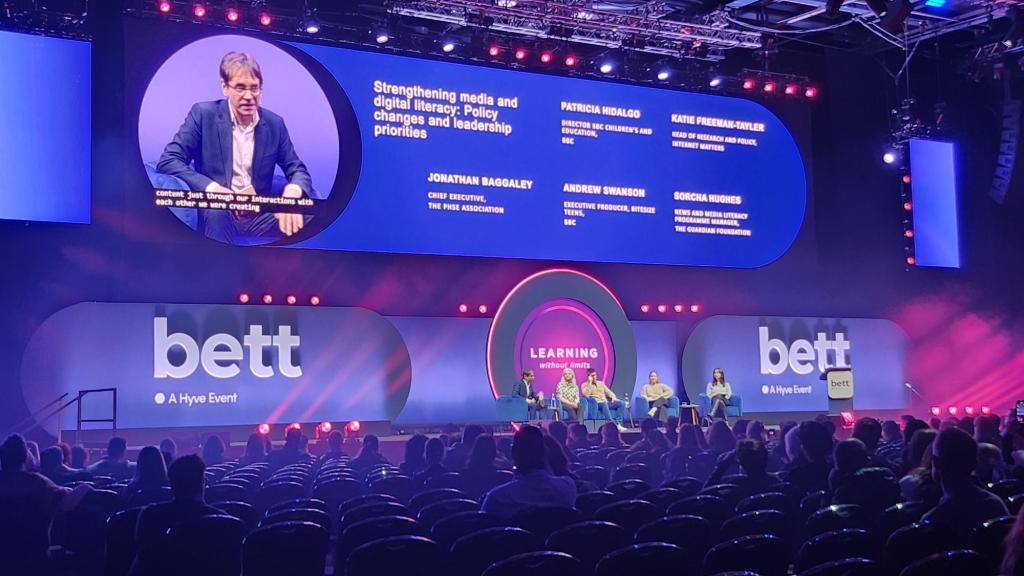
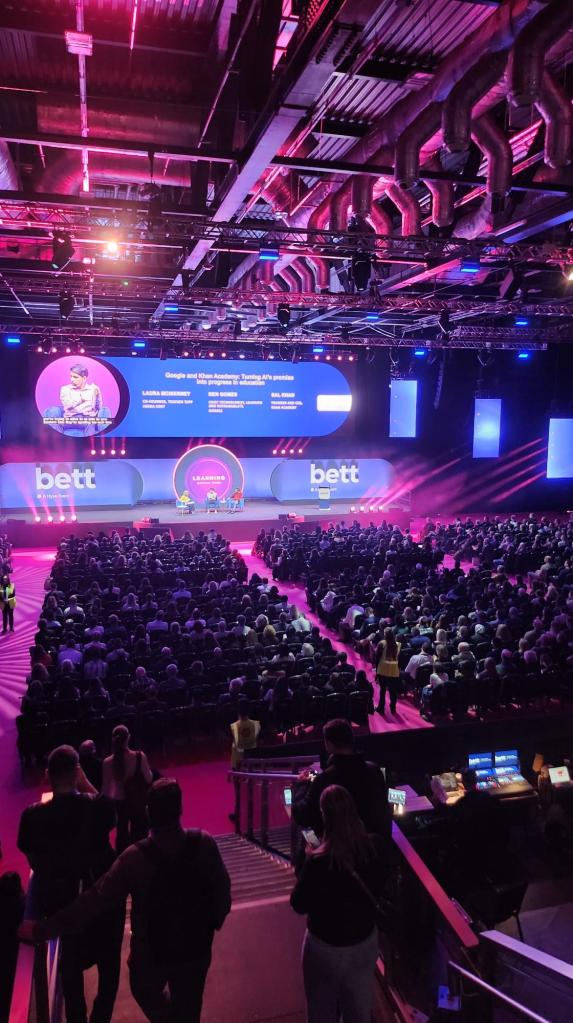
Last week I popped back to London for the #BETT2026 technology in education event at the ExCel. We were there for just one day, but got to see some exciting examples of how digital is shaping and supporting education.
Once again I was blown away by the sheer size of the Excel – I mean, it’s bloody massive! Every time I head down there I forget just how cavernous the place is.
I made some useful contacts made in the AV space (I’m looking to refresh our meeting room kit at the WJEC) and got the chance to listen to the Chief Inspector on how the inspection regime is changing and being updated in England, to keep with the times. Interesting stuff, particularly as a parent of primary school-age children. Some other conversations explored how the digital literacy challenge can be addressed through education (both inside and outside of school).
It was really interesting to see some of the AI tools now at teacher’s disposal. Products designed to lessen the administrative burden for managing lessons, producing lesson plans etc. The talk by Microsoft showing the range of tools available through their Microsoft for Education service was really quite fascinating! Equally fascinating was the show of hands around the room during the demo that showed very few teacher’s were taking advantage of those tools, even though they were already deployed within their organisation. A lesson in adoption, confidence or awareness, I wondered… (maybe all three)
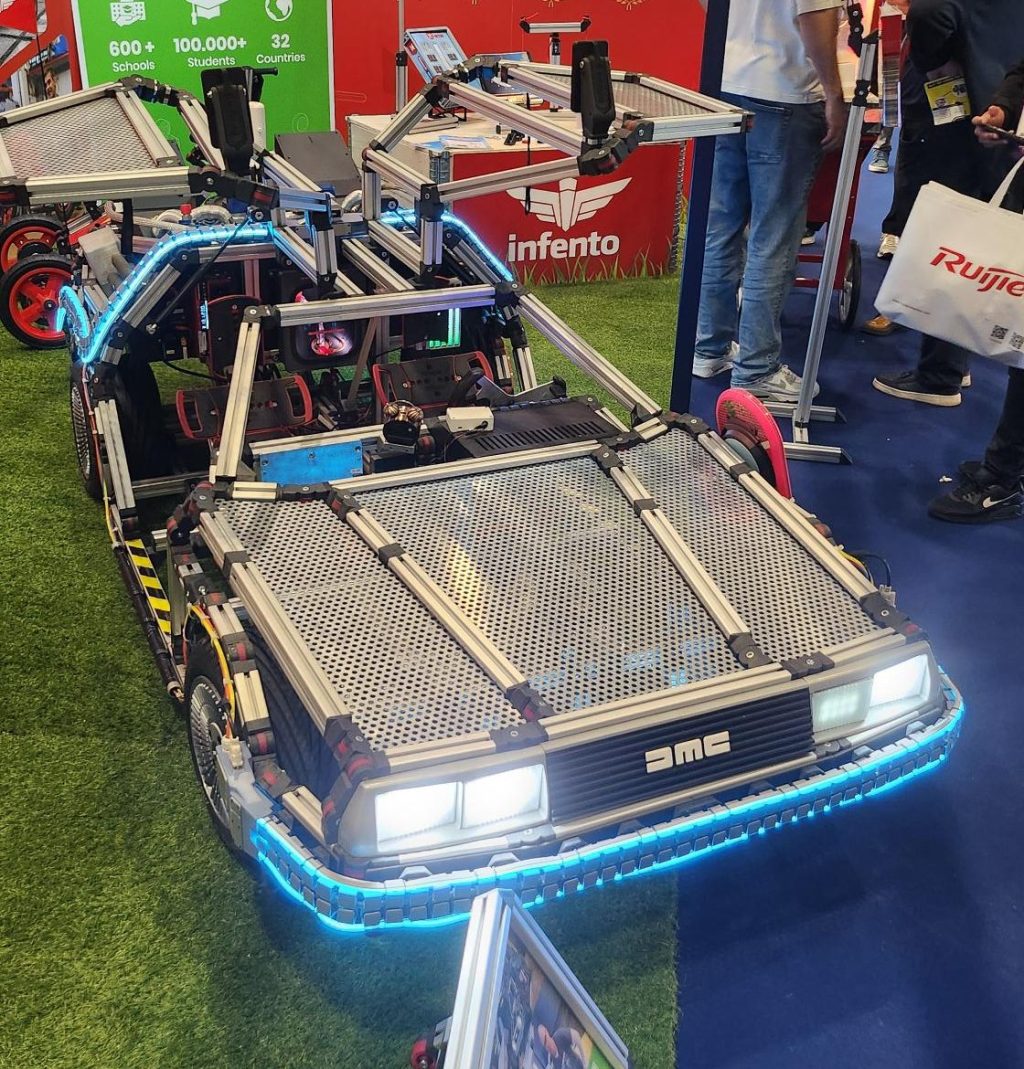
It wasn’t directly relevant to us being there, but I was probably most impressed by the many suppliers on the conference floor who offered innovative ways to bring engineering and technical/coding skills into the classroom. There were some incredible examples, many of which were interactive, for kids to get hands on with technology to make and build some quite remarkable machines. A quick nod here to the firm who had a version of the Delorean from Back to the Future on their stand (see pic at the top of this blog) – amazing!
A side note – the ExCel really needs to improve the Wi-Fi service, it was shockingly bad. I was fortunate in that we didn’t have to pay for a ticket to the event (the WJEC has charitable status), but even so was still pretty frustrated – the Wi-Fi was pretty much unusable. I would have been majorly narked if I had bought a ticket!

Right – I’m already very conscious that this is a ridiculously long blog… so i’ll leave it there for today!
I hope the reflections above are interesting / useful. It’s quite a nice thing to take time out to reflect on these myself, something I often don’t find time to do.
Catch up soon!
 davidmasonhawes.com
Leave a comment